Showing posts with label environment. Show all posts

15 November 2012

An Adventurous and Cautionary Tale of (Non)Fiction: A Review of John Vaillant’s 'The Golden Spruce'


I recently finished reading John Valliant's The Golden Spruce for a graduate-level STS course at Virginia Tech. So immersed in the topic and jazzed about the writing style, I feel compelled to share my review with those beyond the classroom. Without further delay, what follows are my thoughts about an engaging book and important topic. Hopefully my words will foster some feedback and encourage critical thinking about our relationship with nature.

From the first pages of the acknowledgements section (where the author mentions the generous participation of wide assortment of people from various (and at times competing) groups: Native Americans, University of British Columbia (UBC) researchers, representatives from timber industry giant Weyerhaeuser, among various other government representatives and civilians), it is clear that John Vaillant’s text will cover a vast thematic terrain. In fact, the protagonist and the events leading up to the book’s climax require Vaillant to explore an expansive geographic and thematic space. 

Like any good historical narrative, Vaillant combines dynamic personalities with captivating adventure. The Krakauer-style runs throughout The Golden Spruce, but Vaillant’s text is not in any sense an imitation of the former’s prose style. Vaillant combines keen observation, historical accuracy, journalistic narrative all into a Jack London like plot--except everything in Vaillant’s book is painfully real. With a guide book like description, Vaillant vividly recreates the stunning beauty and stark danger of the Queen Charlotte Islands and surround areas. This treacherous areas off the coast of British Columbia “represent[s] a sort of existential intertidal zone--not just between the forest and the sea but between the surface and the spirit worlds.”[1]  In this space the cognitive dissonance that permeates the history of the timber industry is all too apparent. The challenge of reconciling conflicting ideologies is perhaps most starkly obvious in the life and actions of woodsman, timber surveyor, and eco-terrorist Grant Hadwin.

Vaillant relies upon a series of short and interconnected episodic chapters to lay the necessary foundation to support such an intricate narrative. While it might take awhile to arrive at the climactic destination, the importance of each chapter (and the various characters, scenes, and incidents contained therein) cannot be overlooked. Vaillant knew where he wanted to take reader and seems to have worked backwards to connect the beginning and end with a series of detailed anecdotes that propels readers through time, culture, and geography.

Within in the first ten pages of the book, Vaillant reveals the mysterious conclusion of Grant Hadwin’s misadventures. “The kayak and its owner, a Canadian timber surveyor and expert woodsman, had been missing--not for weeks, but for months. This man, it seemed, was on the run, wanted for a strange and unprecedented crime.”[2]  Such an early presentation leaves readers to wonder why this ecologically-attuned man would perform such an ecologically-destructive act. It is the subsequent search for Hadwin’s means and motive that The Golden Spruce explains the historical, cultural, ecological, and personal significance of Pacific Coast trees/timber and more specifically of K’iid K’iyaas (the Haida name for the golden spruce). Tracing a path of celebration, utilization, and deforestation from Mesopotamia through Europe and into New America, Vaillant describes the pivotal role wood has played throughout human history and evolution. Acknowledging the universal importance of wood (e.g. heat, light, shelter, clothing, weapons, etc.), Vaillant is quick to point out the particularly significant role trees and wood products have played in the formation of a distinct North American identity.
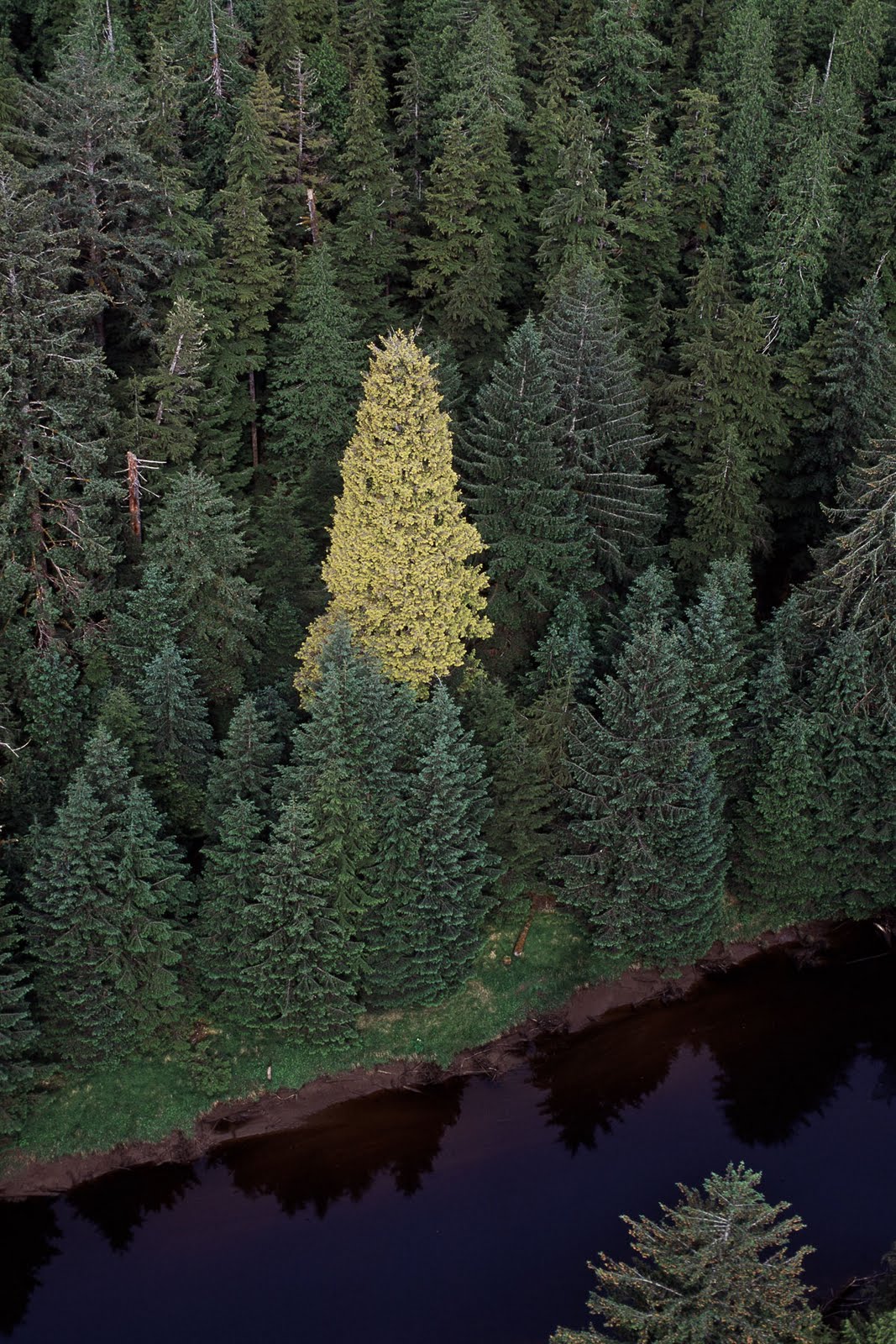
Image of K’iid K’iyaas courtesy of Bondi Resort Blog
Interweaving historical events and characters into a lengthy and detailed narrative of the places and peoples associated with the golden spruce, John Vaillant’s text is richly detailed with a broad, yet focused, purpose. With the golden spruce acting as a sturdy narrative trunk, Valliant’s book branches off into various extended historical episodes that explore humanity’s complex relationship with the environment. Perhaps the most significant critique of the book is the vast number of pages required to arrive at the pivotal moment when, under a cloak of darkness, Hadwin masterfully employs “a Humboldt undercut and...a series of ‘cookies’...leaving just enough holding wood so that the golden spruce would remain standing until the next storm.”[3]  However, it is the broad and branching narrative that allows Vaillant to achieve his analytical depth; which is where the true power of the text resides. Branching into histories of people, places, practices, and the associated technological and ideological developments, The Golden Spruce presents readers with a story about the dynamic connections among human beliefs, relationships, and actions. More importantly though, the book demonstrates the array of consequences that stem from such a complicated web of existence. The felling of K’iid K’iyaas is undoubtedly the focal consequence, but, in the grander scheme of human-environment relations, it is but one of many serious issues.

After nearly ninety pages, the story’s main human character is finally introduced by name. With examination of Grant Hadwin, the narrative begins to loop back and connect to the initial vision of the destroyed kayak and supplies scattered along the Mary Island shoreline. In his treatment of Grant Hadwin (more prolonged and in-depth than with other actors), Vaillant makes clear the cognitive dissonance that is quite common amongst loggers. Alongside the adoration for the dense and vast coastal forests and an intense desire to be outside, timber professionals are actively (and efficiently) participating in the deforestation and consequent elimination of the very areas and occupations they so covet. Vaillant points out the remarkable degree that Hadwin struggled to hold onto these competing ideals. In an industry where “awareness causes pain,”[4]  Grant Hadwin was hyper-aware and thus afflicted by intense pain of this double bind. Thus, he embarked on a quest to fell one symbolic tree in order to illuminate the implications of felling all the trees.

Vaillant points out the human tendency (regardless of culture, time, or place) to view resources in terms of their vastness and seemingly endless abundance. Unfortunately, any sense of humbleness quickly gives way to economic-oriented extraction. “That something as small as a man could have any impact on such a place seems almost laughable. In a geography of this magnitude, one can imagine how it might have been possible to believe that the West Coast bonanza would never end.”[5]  The Northwest Pacific sea otter trade is but one instance that exemplifies this all-too-common aspect of human nature,
“...despite its practical importance, and despite a necessarily keen sensitivity to the rhythms of the natural world, the West Coast Indians pursued this creature to the brink of extinction. In doing so, they demonstrated the same kind of profit-driven shortsightedness that has wiped out dozens of other species, including the Atlantic salmon, and, more recently, the Atlantic cod. It is an eccentric and uniquely human approach to resources.”[6]
With a rather balanced approach Vaillant addresses the consequences of such an approach, but does so without blaming the West Coast Indians. After all, people of all cultures have a long history of acting shortsightedly with regard to resource extraction. Vaillant aptly summarizes the universal cognitive dissonance as a situation where, “Once aboard a juggernaut like this, it appears suicidal to jump off--even if staying on is sure to destroy you in the end.”  [7] While the geography and resources have shifted, this mindset continues to run rampant. Therein lies the problem.

Readers of various ilks will find much to enjoy within John Vaillant’s The Golden Spruce. Whether interested in the history of logging, North American environmental ideologies, First Nations anthropology, labor issues, or looking for a historical crime drama, Vaillant’s book is timely, well-written, engaging, and ultimately an educational cautionary tale. While the author does not take any great effort to conceal his fondness for nature, he does a remarkable job presenting the complicated array of interests associated with golden spruce story. By extension, Vaillant causes readers to acknowledge the complexity inherent to all environmental issues. Never championing nor outright chiding Grant Hadwin, the author presents the main protagonist as a complex and misunderstood individual. In doing so, Vaillant reminds readers to take pause when examining the human-environment relationship. Very intelligent questions are hard to pin down in order to think about, and even harder to answer with any sense of sufficient comprehensiveness. Grant Hadwin’s actions were undeniably radical, but his indictment of the logging industry resonates with many people in the text (and likely with readers as well). We may never know what became of Hadwin, but we can (and should) know that the burden of cognitive dissonance is too much to bear. John Vaillant’s text gives us a reason to make a concerted effort to ask and answer the tough questions about human-environment relations.


  1. John Vaillant, The Golden Spruce: A True Story of Myth, Madness, and Greed (New York: W.W. Norton & Company, 2005), 28.
  2. Ibid., 28.
  3. Ibid., 134.
  4. Ibid., 98.
  5. Ibid., 90.
  6. Ibid., 44.
  7. Ibid., 49.

17 September 2011

Davidson Run for Green Half Marathon

Earlier today I had my biggest running result ever!

Wanting to test my fitness ahead of next month's Chicago Marathon I decided (last week) to enter the Davidson Run for Green half marathon. In planning it seemed like a great opportunity -- not only would the Run for Green half provide a raceday effort for me, but it would also raised money for the Davidson Land Conservancy. Having taught for the Duke Talent Identification Program at Davidson College for two summers, I have fond memories of the numerous miles I logged on the area's roads and trails. Needless to say, I was eager to get back to Davidson for some running. Confident in my fitness and injury-free, I was optimistic going into the race. With two previous half marathons on my running resumé (Baltimore 2010 - 1:29:08 and Outer Banks 2010 - 1:27:45) and a string of 4th place division (male and age category) finishes, I thought it might be possible to break 1:25 and finish in the top 3 of my division (in this case, 30-34 male). Little did I know how well things would go.

When I stopped at Fleet Feet in Huntersville (if your ever in need of running gear and/or local running knowledge, please stop by Birkdale Village and visit them) to purchase some Clif Shot Bloks, the friendly and knowledgeable staff informed me that the race would feature some rather fast runners (i.e. previous and current NCAA runners and olympic hopefuls. There was explicit mention of Kalib Wilkinson, a local superstar high school runner now at Liberty University and sponsored by Brooks). Now, this didn't really put a damper on my race expectations (I never expected to complete at that level -- winning was never on the pre-race radar), but was certainly humbling (and simultaneously motivating). The conversation did cause me to more seriously consider my pre-race preparation. Since the pace was likely to be quick right from the start, I wanted to be near the front to begin, hopefully I would be able to situate myself with a few other runners who were moving at fast, but manageable pace (i.e. one that I could maintain for 13.1 miles).

Well, things definitely started fast. Nearly immediately, Wilkinson pulled away from everyone. He opened a multiple second gap after the first mile. It was impressive. Meanwhile, I managed to mix in with some members of the local running club and a young lady with knee-high compression socks. The pace was quick, but not outlandish. By mile 4 or so, the lead group (save for Wilkinson who was in the lone leader by far) dwindled and I found myself alone with one man from the local club and the aforementioned long socked woman -- it turns out she is Molly Nunn (former Wake Forest distance runner and current olympic hopeful).

Everyone did a their fair share of leading (thus supplying a bit of draft for the other two). As we hit the halfway point and started heading back (my only critique of the race is the rather tight turnaround -- see the map above) toward the start/finish area, the group of three became a group of two as Molly and I increased the pace for a quicker second half.

Without any discussion or plan, Molly and I ended working together to keep the pace up and draft off one another. By sheer happenstance, we ended up running together, each runner silently motivating the other. Strategy was minimal -- work together, talk about specifics as needed, run fast. A generally rolling course, the final few miles did present a few leg burning climbs (short, but steep inclines that required quick bursts of energy to maintain the pace). With longer legs and gait, I opened a small gap on the one of the final climbs.

Nearing the finishing area (which also included a climb), I heard shouts of encouragement coming from behind. Glancing back I could see two things. 1) Molly exclaiming for me to pick up the pace and surge toward the finish and 2) another male runner, who seemingly appeared out of the ether, rapidly closing on me. At this point, all I could think was "move legs, move! you've worked so hard for the entire race, there's no way you can get passed now!" Somewhere from the reserve tank, I harnessed a few remaining atoms of energy (thanks Clif Bar). Through the magic of bodily fission, I split those atoms and released a vast, immeasurable quantify of energy and flat out (or at least what resembled a flat out sprint after 13 miles) sprinted to the finish line. As luck and legs would have it, I finished in 1:22:29, good enough for second place overall! One second faster than Travis Tarbet (Greer, SC) and a humbling twelve minutes slower than Kalib Wilkinson. After our cooperative pacing, Molly crossed the line just a few seconds behind me (1:22:40) and won the women's overall by nearly six minutes.

After the race, Molly and I chatted briefly -- offered congratulations and thank the other for working together throughout the race. At the prize ceremony (oh, yes, I also collected $50 for my effort -- which, I believe is the first time I've ever collected any sort of compensation for running), I spoke with Kalib for a few moments. Super friendly guy (not to mention blazingly fast). It turns out that he is running Chicago and was using today's half as a test of fitness. Small world, huh? After congratulations and wishing each luck in Chicago, it was time to get on with the day (and check out the Davidson Farmers Market).

I've said it before, but the collegiality of runners never fails to impress me. Whether a top-flight athlete, newbie, or anywhere in-between, runners always seem to be the friendliest, most helpful, and consistently encouraging bunch of people. Competitive? Sure, of course. But nary a hint of pretension anywhere.  

Want to know more? Read a pre-race forecast and full post-race report from DavidsonNews.net.

The look of pure excitement and total satisfaction.
A second place finisher's self portrait.


15 April 2011

La Ley De la Madre Tierra (or How Bolivia Inspires Us All)


Bolivia is in the process of passing La Ley De la Madre Tierra (The Law of Mother Earth), which would give nature similar rights as those granted to human beings. The country, governed by Latin America’s first indigenous president, Evo Morales, plans to establish 11 laws for Earth. According to the Guardian, there would include:
the right to life and to exist; the right to continue vital cycles and processes free from human alteration; the right to pure water and clean air; the right to balance; the right not to be polluted; the right to not have cellular structure modified or genetically altered; and the right to not be affected by mega-infrastructure and development projects that affect the balance of ecosystems and the local inhabitant communities.
The Guardian also states, the Bolivian government is planning to “establish a ministry of mother earth” and appoint to it an ombudsman. For specific details about the draft legislation and other specifics, please refer to the embedded copy of Ley de Derechos de la Madre Tierra at the bottom of the post.

We've talked at some length (in a course I'm teaching - ALS 2984) about the quinoa commodification crisis in Bolivia, but there are a variety of other environmental/economic/sociocultural issues at play. Some of Bolivia’s environmental woes stem from its heavy mining of raw materials, including tin, silver and gold. The underlying hope is that Ley De la Madre Tierra will help protect nature before it’s far too late. Undarico Pinto, the leader of the Confederación Sindical Única de Trabajadores Campesinos de Bolivia told the Guardian that the law ” …will make industry more transparent. It will allow people to regulate industry at national, regional and local levels.”

The law, which is still in draft form (see copy below), comes as a part of the complete re-organization of the Bolivian legal system, which is, according to reports, being influenced by an indigenous view of nature (what does this mean for Bolivia? for South American politics? What would this mean in a USA context?). The country’s indigenous spiritual beliefs put the Earth deity, Pachamama (who, it is important to note, is conceptualized as a living being) “at the center of all life.” When interviewed, Foreign Minister David Choquehuanca emphasized Bolivia's traditional indigenous respect for Pachamama was vital to prevent climate change. Perhaps we'll see similar success with La Ley De la Madre Tierra.

As reported in the aforementioned Guardian article, the current draft of The Law of Mother Earth reads:
She is sacred, fertile and the source of life that feeds and cares for all living beings in her womb. She is in permanent balance, harmony and communication with the cosmos. She is comprised of all ecosystems and living beings, and their self-organisation.
While undoubtedly a welcome and remarkably innovative change in policy, one mustn't overlook Ecuador's similar attempt to grant inalienable rights to Madre Tierra. Guardian journalist John Vidal is quick to point out that "new laws are not expected to stop industry in its tracks...it is not clear yet what actual protection the new rights will give in court to bugs, insects and ecosystems." This is a difficult type of calculus that philosophers, economists, biologists, ecologists, and various others have been struggling with for decades. Bolivia may not get the initial equation 100% correct, but they certain are creating an excellent precedent, clearing the path for others to follow. Perhaps through collaborative moralistic-hedonic mathematics we can arrive at a more systems-oriented approach to policy formation (or what you might call a politics of biotic community-ism).

For more information (I've borrowed [with attribution and appreciation] heavily from Wend and the Guardian) see Wend, The Raw Story, Guardian, a super brief Wikipedia entry (perhaps a reader of this blog [or all the readers] could conduct a bit of La Ley De la Madre Tierra research and add depth and detail to the Wiki entry?), and the Government of Bolivia (in Spanish).

Ley de Derechos de la Madre Tierra - Estado Plurinacional de Bolivia

28 September 2010

chaucer for the faithful & some other thoughts


For out of olde feldes, as men seith,
Cometh al this newe corn fro yeer to yere;
And out of olde bookes, in good feith,
Cometh al this newe science that men lere.
But now to purpos as of this matere--
To rede forth it gan me so delyte,
That al the day me thoughte but a lyte.

Please allow me to offer the above stanza from Parliament of Fowls as a means of apology for the long pause in blogging activity. By no means does this represent a dearth of intellectual stimuli nor a diminished interest in sharing my thoughts, whims, and musings with you, my dearly devoted readers (assuming of course that this already minute body of readers is still interested). Arguably out of context, but nonetheless pertinent, Chaucer explains that a devotion to and enthusiasm for learning and reading can cause hours, even an entire day to pass with surprising speed (To rede forth it gan me so delyte,/That al the day me thoughte but a lyte.). Just as the narrator finds himself in the zone (so to speak) and amazed by the quick passage of the day immersed in Cicero's Somnium Scipionis (and therefore we assume also in Macrobius's Commentary on the Scipio's Dream [for the author and his commentary are singlehandedly responsible for the preservation Cicero's De re publica), I too have been in the intellectual zone, devoted to a variety of academic pursuits and am shocked to find myself in the final week of September 2010. Rest assured that this entry signifies a new stage in the digital publication of my wandering thoughts.


Before I digress further, I want to draw your attention to the initial inspiration for this rhizomatic posting. While perusing the limitless depths of the Internet (why is it that we speak of the Internet as an infinite space, but seem to always hover around a handful of sites [or it this one of my unique behaviors]?), I found myself (not so much by chance) at patagonia.com. Quickly however, I moved from the inviting homepage and onto The Cleanest Line, a "Weblog for the employees, friends and customers of the outdoor clothing company Patagonia." Ah, the power of words. All it took was a title: The 2010 Kids' Catalog Backstory: More About Hiking Lessons. Well worth the venture via hyperlink, I immediately thought about distributing this encouraging piece to others. Writing. Education. And outdoor adventuring? What a great combination! I encourage you to take a quick (really, it is short, invigorating, and includes some good photos) read and follow some of the links to Outdoor Education @ SBMS and Hiking Lessons by Lexi Aquillino (a middle school student whose aforementioned piece now appears as the flagship piece in the kids's Fall 2010 Patagonia catalog). It's really cool stuff; well worth a few moment of diversion from whatever you are doing (after reading this of course).

Another stimulating and connected discovery can be found here, here, and/or here. I've not yet read the book nor watched the documentary, but am admittedly excited to read/watch.

More good things to come soon (and on a more regularly recurring basis).