Showing posts with label travel. Show all posts

22 January 2013

Not Just Another Sport

In a short film celebrating the launch of the new Rapha kit, a handful of Team Sky riders discuss the highs and the lows of racing, their ambitions for the season ahead, and why cycling is so much more than just an ordinary sport.

While there are many great themes and phrases throughout the eight minute film, I think Peter Kennaugh's sentiments about the ubiquitous influence and education of cycling nicely sums up my longstanding commitment to the sport and culture. Cycling has taught me "about culture, about food...taught me about the body...you just learn so much about everything. About every aspect of life through cycling. The traveling you do, the different people you talk to and come into contact with."

Relax. Watch and enjoy. Then grab your bike and go for a ride.

02 June 2012

Race Day in Stockholm


I'm about to pin on bib number 851 and head ou the door to (hopefully) run a sub three hour marathon. Unfortunately the rain is still here (not sure about the wind, I've not dared to step outside yet - never mind, a huge gust just rattled the window!) and the temperature are holding steady at 41 degrees Fahrenheit. After being jolted awake by a ridiculously painful cramp in my left calf, the rest of the morning has nicely followed my pre-race plans. Caffeinated by Löfbergs Lila, fueled by Justin's Maple Almond Butter, lingonberry jam, bakery bread, a pink lady apple, Renée Voltaire Fruity & Nutty Müsli, and Arla Ekologisk Mild Lättyoghurt, socked by CEP, and shod in Brooks, I am ready to take on the day and zip through a very important 42.195km!

Here are the details: The first wave of the 2012 ASICS Stockholm Marathon begins today at noon. Approximately 21,000 runners from all over the world have entered. Although predominantly Swedes, the field is still rather international. A total of 83 countries are represented in the race with 7,918 runners from countries other than Sweden. As expected, most of the international runners come from nearby European neighbors -- Finland (4,858), Germany (580), Norway (366), Denmark (330), Great Britain (324), Italy (a surprisingly high 235 entrants), France (213), and then USA with 173 runners.

A huge thanks to each of the 3,165 volunteers who make this race day possible!

Can't make it to Stockholm? Keep tabs and cheer me on digitally - live results here.

Post-race details coming later...


01 June 2012

Hej from Stockholm


After spending the bulk of the day trekking around Stockholm in a less-than-pleasant cold rain with frequent gusts of bone-chilling wind (people were actually throwing away their umbrellas in defeat - see above for photo documentation), I am now settling in and taking care of final preparations for tomorrow's race. Since the most recent news item on the marathon website warns:
The weather forecast says that the temperature will be 8 degrees Celsius during Saturday, and this is a very chilly weather for the season. The coldest Stockholm Marathon ever is the 1987 race when it was 7 degrees. The warmest year was 1982 with 32 degrees.
much of today was focused on finding appropriate clothing for such unexpected weather. Having packed for Stockholm's awesome 60-70 degree weather from two weeks ago (for those who don't know, I've been in Europe since 18 May facilitating a graduate student study abroad trip), I'm rather ill prepared for the expected race time conditions. The combination of inhospitable weather, running shorts (of the really short variety), and singlet should make for an interesting race. Quite nervous about tomorrow's race, I'm still not entirely sure what to wear for a forecasted high of 48 degrees, wind, and rain. Although a rather miserable forecast, I don't want to over insulate (this would be ok for training, but for a full-exertion racing situation, where the race bib must beware on the outside, it is critical to get things right and get them right from the start). As I discovered in Bozeman this past November, even in cold conditions, too many layers can make for a truly exhausting race. After much searching. I settled on a pair of CEP compression socks and a long sleeve Nike top made of a polyester and merino wool blend with a 1/4 zip and thumb loops/fold over hand mitts (thanks Löplabbet for having both items in stock and providing great customer service). So much for keeping things consistent ahead of a major event!

If you are interested in keep track of my race progress (bib number 851), the ASICS Stockholm Marathon website will provide intermediate splits for each runner. Additionally, in the USA, Universal Sports Network will air multiplatform coverage of the 2012 ASICS Stockholm Marathon on Saturday, 2 June. Television coverage will air from 3:00 pm – 4:00 pm ET with expert commentary and analysis from longtime running commentator Toni Reavis and elite distance runner Josh Cox. In addition, UniversalSports.com will provide live online coverage of the race $4.99. Review the marathon website for ore details about viewing options around the world.

Although my spring training was sporadic (longest run since Chicago was 15 miles) and I'm still struggling with a pulled hamstring, I remain optimistic about the possibility of finishing under three hours. That said, even if I am unable to break the three hour mark, I am thrilled to have this opportunity to run in Stockholm!

Since race day is rapidly approaching, I am going to keep this brief and rely upon images and a few well placed words to summarize the past 24 hours in Stockholm.

After landing at Arlanda Airport, I zoomed into the city centre aboard the convenient and rather swanky (it conveys a sort of James Bond feel) Arlanda Express train.


After navigating the T-Bana, I found my way to the Gärdet district in central Stockholm. Part of the world’s first national city park, Gärdet features expansive fields with fantastic areas for running (or post-marathon recovery walks). Strolling through a lovely wooded park, I eventually emerged to find my clean, inviting, and snug little hostel.


After a relaxing evening, this morning I set out for the marathon registration expo. Along the way I was greeted by a number of encouraging visuals.


Eventually I made my way to Stockholm Stadion (home of the 1912 Olympics)


After completing the official registration process, I enjoyed a complimentary pasta lunch and listened to some American rock n roll classics as belted out by a Swedish band. All things considered, a pretty awesome (albeit darn cold and damp) lunch!


The weather might not be great, but it will be amazing to complete 42.195km on the official Olympic track.


The rest of the day involved an afternoon coffee break and lots of leisurely strolling around Stockholms Stad. Stockholm is an absolutely beautiful city (I'm excited to have some more time on Sunday and Monday to explore more the city with more breadth). However, I am surprised to find the city terrain rather hilly. Hopefully the gorgeousness of the cityscape will distract me from the undulating terrain during tomorrow's marathon.


Now that I've had some dinner, prepared my gear for the morning, and completed a light workout, it is time to let go of my nervous energy and get some rest.


09 March 2012

Stockholm Marathon - A Somewhat Hasty Decision

Well, the decision has been made! Just moments ago, I signed up to run the 2012 Asics Stockholm Marathon! During a moment of caffeinated enthusiasm (mixed with a smidge of procrastination) at Sola Cafe, I committed to traversing 42.195 Swedish kilometers as swiftly and smoothly as possible on the first Saturday of June.

Although I've been searching for a spring marathon for quite some time, I was not sure that Stockholm was even a possibility until yesterday afternoon. Having missed the December registration deadline, I added my name to the waiting list in early January. Cautiously hopeful that a spot might open, I also acknowledged the strong probability that I would not be racing in Sweden this year. A luck would have it, my name was placed nar the top of the waiting list. After receiving an email offering late registration via waiting list, I raced (digitally) to ensure I could coordinate travel plans, create an affordable budget, and adequately train for the 2 June race. With only a few days provided to accept the offer, I was eager to jump at the opportunity, but was a bit worried about establishing a sufficiently preparatory three month training timeline (hanning struggled with post-Chile illness and some Achilles tenderness/tendinitis my late winter/early spring training has been quite sporadic). All my concerns aside, I could not find a reason to bypass an opportunity to race in Stockholm. Thus, with just an hour remaining until the expiration of my registration offer, I pulled out my credit card and clicked on the registration hyperlink. Unfortunately, a defunct link dampened my enthusiasm. Since this problem occurred during the wee hours of the Swedish morning, there was no chance for a quick fix before the deadline. hoping for some leniency, I promptly emailed the race organizers in Stockholm explaining the problem and seeking late registration for the event. Thankfully, the race officials were incredibly understanding and more than happy accommodate my URL issues. Immediately upon receiving their positive response, I paused my academic endeavors and attended to the more pressing marathon registration.

Why Stockholm? Well, I happen to be fortunate enough to hold a fellowship with Dr. Karen DePauw, Dean and Vice President for Graduate Education at Virginia Tech, which provides me to travel to Europe in May. Since I'll already be in Europe, why not schedule a race at the end of the program (hopefully, I'm not too exhausted from the whirlwind itinerary)? One component of my fellowship involves duties as assistant facilitator for the Global Perspectives Program. As such, I will find myself leading a group of graduate students through a tour of universities in Switzerland, France, and, Italy during May. Aimed at fostering a global perspective on higher education, this study abroad experience develops a comparative understanding of how culture and context influences the establishment and evolution of higher education systems. By the conclusion of the trip, I hope that each participant will have a more complete (and comparative) understanding of US and European university systems, meet new international colleagues, establish research collaborations and cultural exchanges, and appreciate the people, culture, cuisine, and geography of Switzerland, France, and Italy.

According to the rather robust marathon website:

It is basically a two-lap course through the central parts of Stockholm. The surroundings vary from the woods of the Royal park "Djurgården" to the streets of a big city. The course passes buildings such as the Royal Palace, the City Hall, the Royal Opera and the Houses of Parliament. The course is one of the most scenic in the world. Much of the race is run along beautiful waterways.When passing the "Västerbron" bridge, the runners will enjoy a fantastic view over a city with buildings ranging in age from the medieval times to the present day. The difference in altitude between the highest and the lowest point of the course is 29 meters.Start just outside the Olympic Stadium and finish inside the beautiful arena. The first lap is 16.6 kilometres, the second lap 25.6 kilometres.

The elevation profile reveals an undulating course through historical, urban, and natural areas of stokckholm. The periodic peaks represent the many brief, yet steep, bridges that connect the various islands that compromise the Stockholm metropolitan area. Although not as consistently flat as the Chicago course, I still hope that Stockholm will enable a swift marrathoning time. At the very least, the newness (and what I expect to be general fabulousness) of the cityscape should make for an amazing running experience.

So, if you happened to be in (or near) Stocholm in early June, please try to save some energy for early afternoon (the race begins at 12:00pm, so you can enjoy a leisurely morning and still have time for fika in the afternoon) cheering along what is certain to be an architecturally, historically, and all-around outstanding marathon corse.


12 December 2011

UC, a primer

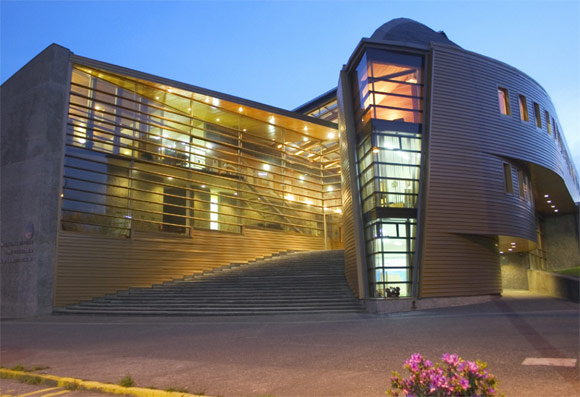
A glimpse of UC's Villarrica Regional Campus. Located 750 km south of
Santiago, in “La Araucanía” Region, the Villarrica Regional Campus
focuses on the training of general Elementary Education

Margo and I are putting together a brief overview of Pontificia Universidad Católica de Chile to share with our GPP Chile colleagues during our final pre-trip meeting. What follows is a quick summary of the highlights we plan to cover.

Mission Statement
To achieve excellence in the creation and transfer of knowledge and training of people, inspired by a Catholic understanding and always at the service of the Church and Society.

History in Brief
  • Founded on 21 June 1888 by the initiative of the Archbishop of Santiago, Monsignor Mariano Casanova
  • Initial Goal:
    • create an institution that integrated academic excellence and inspired training in Christina doctrine
  • Declared a pontifical university by Pope Pius XI in 1930
  • Granted full academic autonomy by the Chilean government in 1931
  • First two schools were for Law and the Physical Sciences and Math
  • First graduates were civil engineers, architects, and law graduates

Demographics
  • Enrollment (2010): 22,122
    • ~ 2400 masters students
    • ~ 800 doctorate students
    • ~ 800 post-doctorate students
    • ~ 1,500 full-time faculty

Faculties (roughly equivalent to "colleges" in the US university system)
  • College UC
    • Bachelor of Natural Sciences and Mathematics
    • Bachelor of Social Science
    • Bachelor of Arts and Humanities
  • Faculty of Agronomy & Forest Engineering
  • Faculty of Architecture, Design, and Urban Studies
  • Faculty of Arts Faculty of Biological Sciences
  • Faculty of Economic and Administrative Sciences
  • Faculty of Social Sciences
  • Faculty of Communications
  • Arts Faculty
  • Faculty of Law
  • Faculty of Language and Literature
  • Faculty of Education
  • Faculty of Engineering
  • Faculty of Philosophy
  • Faculty of Physics
  • Faculty of History, Geography, and Political Science
  • Faculty of Mathematics
  • Faculty of Chemistry
  • Faculty of Theology

Interesting Facts
  • 1 of 6 Catholic Universities in Chile
  • 1 of 2 Pontifical Universities in Chile
    • Catholic University established by and directly under the authority of the Holy See
    • Licensed to grant academic degrees in sacred faculties, the most important of which are:
      • Sacred Theology
      • Canon Law
      • Sacred Scripture and Philosophy
    • Pontifical universities follow a European system of degrees in the sacred faculties, granting the baccalaureate, the licentiate, and the doctorate
  • 4 Campuses in Santiago
    • “The four Santiago campuses have been selected, adapted, and designed to meet the needs of the fields of study offered on each campus within a rapidly developing urban setting.”

Villarrica Campus
  • “The Villarrica Regional Campus is located 750 km south of Santiago, in “La Araucanía” Region, where the density of the Mapuche population living in Chilean rural areas is the highest.”
  • “The main activity of this campus is the training of general Elementary Education teachers who attain a solid humanist emphasis, commit to Christian values, and have the competencies to conduct themselves in a globalized, culturally heterogeneous world that is marked by the use of new technologies.”

More Fun Factoids
  • Virtual campus which enables students to contact scholars from other parts of the world
  • 2009 - ranked best Chilean university and the second best in South America
  • Law school is currently ranked 1st in Latin America
  • Alma mater of Sebastían Piñera (current Chilean president)
  • Offers several double degrees at the graduate level with universities in other countries


30 November 2011

Sense of Place

Well NPR, you've done it again.

Pure brilliance. That is perhaps the most accurate way to describe the new Sense of Place (intellectual confession -- I'm fascinated by notions of place -- how do we identify with where we're from/have been/are? what makes a place special? ideas of native/immigrant? what are local artifacts in no-longer-localized world? etc. -- maybe a research project is forthcoming -- traversing the technoscape: music, literature, food, and our sense of place [title is a work in progress -- suggestions are welcome]) feature from NPR Music. With this new quarterly series, David Dye and crew "hope to give you [and me] an idea of the past and present of the local music scene and some pointers for musicians or music-lovers planning a visit." What a smashing idea!

And where do you imagine this magical musical tour should begin...

Ireland, of course!

A destination of complexity, Be sure to listen to World Cafe's comprehensive (rather surprisingly given its less than 17 minute duration) history of contemporary Irish music -- with particular focus on the Dublin music scene. Glen Hansard's "Ireland...is a beautiful girl" introduction is reason enough to pause whatever you are doing and listen to the broadcast. The associated text is quite brief, give it a perusal, but definitely listen to the broadcast -- and then download some Irish music (e.g. The Frames, The Swell Season, Lisa Hannigan, Villagers,  Sinéad O'Connor, oh and maybe less known bands such as U2 or Van Morrison).

And to top things off, here's Glen's walking tour of Dublin (be sure to take a few moments to explore the interactive map)


18 October 2011

CHE Reports from Santiago

image courtesy of The Chronicle of Higher Education

No, not Guevara (although I imagine he'd support the movement), but rather The Chronicle of Higher Education. An article in today's CHE examines the intricacies of the prolonged conflict over high tuition costs that lead to heavy personal debt (sound at all familiar to any current happenings in the US?). The article is fascinating for a variety of reasons. Not least of all is its framing of the concerns in contemporary Chilean higher education (which in many ways seem to be a microcosm of larger, global higher education topics). The article also builds nicely upon (or is, at the very least, tangential to) much of what Jordan has been writing about in his blog.

It doesn't really serve for me to recap the article in its entirety (in fact, I suggest we all read the article before meeting on Thursday morning; it's relatively short, very informative, and incredibly pertinent -- great for reading during a mid-afternoon coffee break), but I do want to draw your attention to a few key areas. CHE reporter Andrew Downie focuses a lot of effort (understandably so) on explaining the origin of the ongoing protests. Attempting to explain the impetus behind the protests, Downie states,
The question of why such protests have erupted in Chile, the country that is by many measures the most advanced in South America and the one that spends most on education, might seem perplexing to outside observers. The answer, say experts, is in the question: The unrest is precisely because of the country's leap forward.
Despite the money spent on education, many Chileans are criticizing the lack of reform in higher education. Indeed, these apparent leaps have been more closely resembled unimpassioned hops. Describing what he calls a "Failed 'Revolution,'" Downie explains,
The seeds of protest were sown in December, when the education minister said the government would begin a "revolution" in higher education. Previous governments had avoided higher-education reform, preferring to concentrate on elementary and secondary education, and the announcement was a welcome surprise to many. 
But when the government finally revealed only timid reforms, in May, there was widespread disappointment, says José Joaquin Brunner, who is one of Chile's most respected professors and education researchers.
While there are many variables at play in this social movement, the reporting about and from Chile emphasizes the widespread public support behind the protests.
Many shops, banks, and stores are boarded up for security, but the students retain widespread support from ordinary Chileans, with the polls consistently showing more than 70 percent backing their cause.
No matter how unreliable public polling may be, this is a significant point to keep in mind while reviewing the remainder of the article (and generally contemplating the movement). With so much popular support, one might assume the protests would lead to a swift sea change in Chilean higher education; remedying many of the earlier, yet still inchoate, reforms. Well, yes and no. The article concludes on a positive (albeit cautious) note:
If nothing else, the conflict has made reform now seem unavoidable. But a resolution could still be months away, and there is widespread concern that students will lose this academic year entirely. That would put hundreds of thousands of degrees into question and perhaps even threaten the survival of some universities, particularly the less wealthy ones, in the provinces. Neither the students nor the government is likely to end up satisfied, but most people believe the overall outcome will be positive.
This fuzzy optimism seems particularly important for each of us (as socially and intellectually engaged travelers  with particular observational focus on Chilean higher education) to consider. Although it is difficult to accurately forecast the path of the protests or the route to reform, these topics will undoubtedly be on the public's mind when we visit Chile in January. It serves well for each of us to be as knowledgeable as possible, while still remaining intellectually open (i.e. not to rush to judgement based upon preconceived notions resulting from foreign reporting, media bias, presumptions regarding the nature of social protest, lack of cultural context, etc.). Just one of the many topics to keep on the critically conscious radar before, during, and after our immersive whirlwind tour of Chilean higher education.

Still interested (I hope so)? Here's a brief archival selection of CHE coverage of related issues in South American higher education:


04 October 2011

Pre-Trip Reading

Image courtesy of "Tao of Travel" by way of
Henry Shukman's NY Times review of the text. 
During my daily perusal of all things Chile, I came upon this excerpt from Lonely Planet’s Chile and Easter Island guide. Relying upon images and captions the excerpt is quite brief, but still covers a good selection of pre-travel literature. Even a quick skim of a few pages will help perk your interest and bring your cultural/historical/political lens into better focus.

While I cannot speak to the literary quality narrative intrigue of each text, I am willing to personally vouch for Chatwin's In Patagonia, any and all of Neruda's poetry, and Guevara's Motorcycle Diaries (I must [somewhat sheepishly] admit this recommendation is based on my analysis of the film adaptation of the text [but it was a film that I taught in one of my classes;  to demonstrate my literary and academic credentials - given my review of other Guevara texts, I'm willing to help contextualize the flim/text a bit more]). In addition to the Lonely Planet list, I encourage you to hunt down a copy of Neruda's Memoirs, Theroux's Old Patagonia Express and The Tao of Travel: Enlightenments from Lives on the Road (not specifically focused on Chile, but a great read for travel enthusiasts, students of cultural mindfulness, or anyone planning/hoping to travel), as well as a dual-authored text from Chatwin and Theroux - Patagonia Revisited.

30 September 2011

Running with Ryan

Ryan Hall cresting Boston's Heartbreak Hill.
Check out that form and pace. Amazing!
Or at least behind him. Probably well behind him. With a personal marathon record of 2:04:58 (2011 Boston Marathon**) and having just placed fourth at the Rock 'n' Roll Half Marathon (4 September 2011) in Virginia Beach, VA, in 1:03:01, the only glimpse I'll have of Hall will likely come in the start corral. Even then, he'll be seeking pre-race serenity at the head of the Elite Corral while I jockey for breathing room in the commoners' B Corral. Still though, the field of elite runners competing at Chicago should provide for amazing spectating. If you're planning to drive, run, or ride to the marathon, don't forget to glance at the helpful info in the 2011 Bank of America Chicago Marathon Spectator Guide and website. Regardless if you're attending the marathon, there is loads of interesting  information available at the Runner's World site dedicated to the Chicago Marathon. 


An exciting development in the world of health and wellness.
Learn more about the recent Westin -- New Balance
health and fitness partnership here, here, or here.

In other exciting running and general health & fitness news, Westin Hotels & Resorts has partnered with New Balance (a great company that I think we all [no matter or running shoe preferences -- mine  conveniently happens to be NB] can get behind) to provide guests with complimentary athletic shoes and apparel during their stay. As the press release explains,
During their stay, guests can borrow running shoes with brand new, disposable insoles for each use, as well as a variety of men’s and women’s apparel including shorts, shirts and socks for men and shorts, capri pants, shirts, sports bras and socks for women. 
While there are some less-than-stellar aspects of this program (largely involving the disposal nature of some of the products -- but then again, there are some health concerns [e.g. MRSA, etc.] that probably make full-scale reusability a bit unrealistic), the overall concept is simply outstanding. The creation of a program that encourages more people to become more active must be applauded. Sure, there are some issues of accessibility (i.e. if you can afford to lodge at a Westin, you probably don't have any trouble affording fitness gear), this could very well initiate a wider hotel fitness trend. Although the Westin website states "Westin has recently partnered with New Balance to provide athletic shoes and apparel during your stay, for a fee,"the exact price of the program is not published anywhere. In fact, there is some discrepancy about the existence of the fee at all. Reports and press releases seem to indicate that the program will be available to Westin guests free of charge. In his WSJ overview and analysis of the hoteling trend "to beef up fitness offerings" Kevin Helliker stresses the no-charge aspect of the program, but the proceeds to question its appeal,
Westin Hotels & Resorts is launching a free program to loan guests New Balance-brand fitness shoes and apparel. But will road-warriors really want to wear communal running socks? 
Under the new "gear-lending" program, to be launched Tuesday, women will receive Capri pants, a sports bra, shirt, socks and shoes. Men will get a shirt, shorts, socks and shoes. Between uses, Westin says the clothes will undergo the same intense hot-water laundry process used on hotel sheets and towels. Also, the exterior of shoes will be cleaned and the inner soles will be replaced between guests.
Communal running socks? Come on Helliker. All of the official sites and releases emphatically state, "Shoes come with socks that are brand new and apparel is provided fresh and clean." Either the uproar over wearing laundered socks caused a re-evaluation of the program or Helliker's reporting was questionable. Suppose it doesn't really matter in the grad scheme of things. But, it seems important to make the program appealing and don't allow inaccurate reporting to discourage guests from taking advantage of an opportunity to improve their quality of life and health via exercise. Some food for thought if you ever find yourself at a Westin and in need of running gear.

And finally, my moment of marathon zen...


A bit of Obama inspired motivation after Barcelona's astonishing 2009 season (Josep "Pep" Guardiola is the current Barcelona manager [and former player]). During this dream of a season, Barcelona not only became the first club in Spain to win the treble (La Liga, Copa del Rey, & Champions League), but also became the first football club ever to win six out of six competitions in a single year -- or the never-thought-plausible sextuple (the aforementioned treble & the Spanish Super Cup, UEFA Super Cup and FIFA Club World Cup). I'm hoping that if I recite this mantra (in addition to whatever song happens to imbed itself in my subconscious) during the race, a bit of Pep magic will help propel my legs and fill my lungs. We'll see. Superstitions are encouraging and motivational, right?

**Boston Marathon, 18 April 2011 -- Hall ran the fastest marathon ever by an American, finished fourth, but not an American record because the Boston course is not eligible for records owing to its point-to-point layout and its elevation drop of greater than 1 meter per kilometer. A kind (i.e. very strong) net tailwind (15-20 miles/hour) contributed to the runners' remarkable 2011 times (Kenya's Geoffrey Mutai ran 57 seconds under the recognized world record in winning in 2:03:02, but again, not a new official world record).

03 August 2011

"Running" Bozeman's M Trail

photo courtesy of AllBozeman.com
Veer right at the trailhead and you'll quickly find a rather nondescript sign warning, "Steep trail, hike at your own risk" (or something to that effect -- verbatim memory of the exact words has been overwritten [sort of like a mental palimpsest] by memories of a dehydrating, scree-scrambling run up a near-vertical trail). Gazing up from the parking lot, the College M certainly appears far away, but not impossibly so. A runner is likely to find reassurance from the easy pitch and nicely manicured surface. At least for the first few meters. If not deterred by the sun blazoned white sign with foreboding black text (oddly reminiscent of a sign one might find along a seldom traveled country [most likely gravel] road), the runner will be rewarded with a short, albeit lung scorching and leg burning, ascent to one of the finest views of the Gallatin Valley. A quick drive from downtown Bozeman (approximately six miles north/northeast of downtown), the College M Trail is relatively accessible to nearly all tourists, students, and full-time residents. Despite its proximity, the trail should not be confused with a casual Sunday stroll. That said, there are a few trail options with varying degrees of difficulty. Depending upon your fondness for steepness and/or desire for shaded switchbacks, there are a handful of approaches to suite nearly all fitness levels. Water, sturdy footwear, and a positive attitude should suffice (you can probably leave the bear spray at home for this excursion). Speedy traverse and elevated heart rate are negotiable (or at least the specific numbers).

view from the seemingly innocent trailhead
I'll leave the details to the experts:

Description from TripAdvisor.com
"The large white M that overlooks Bozeman from the south slope of Baldy Mountain is accessible from a trailhead and trails managed by the Gallatin National Forest. The trailhead is located on Rt 86 at the mouth of Bridger Canyon. The 250-ft long letter M was made from whitewashed rocks built by students from Montana State University in 1915. 
The vertical elevation from trailhead to the top of the M is approximately 850 ft. The elevation  at the M is approximately 5,800 ft. Elevation at the trailhead is approx 4,950 ft. There are multiple trails ranging from medium to hard. The western trail (turn left at the trailhead) is easier, with many switchbacks and a more meandering trail to the top. There are some very nice outlooks over the Gallatin Valley from this trail. Part of the trail cuts through fir and juniper forest. There are some alternate trails up this side. 
The eastern trail runs up the ridge, and is a more direct and shorter route. However, the steep slope on rock requires more caution, hiking boots and possibly walking stick(s).This trail offers better views of Bozeman and the surrounding area and mountains. Hiking down this trail is hazardous because of loose stone and rock, use caution. The main trail up through the Bridger Mountain Range branches off from this route about halfway up. 
Plan on up to 2 hours for up and down trip with time at the top to rest and take pictures. Trails are not marked, but well worn paths are sufficient for non-winter hiking. A water bottle is suggested. Winter hiking is not suggested without proper equipment and training."
these colorful caterpillars are frequent running companions along the M Trail
can anyone identify the species?
summit photo after a leg burning 12 minute,
16 second "run" up the eastern branch of the trail  
Sampling of informative warnings from AllBozeman.com
The right fork leading to the M is steep, following the ridge. The left fork to the M is a kinder, gentler ascent, via switchbacks. 
Located on the south side of Baldy Mountain overlooking Gallatin Valley, the “M” trail is accessed via the trailhead at Route 86 in Bridger Canyon. The “M” rock letter formation sits about 6,000 feet high from the roughly 5,000-foot high trailhead. 
Winter can make hiking the M more difficult due to low temperatures and snow so take any necessary precautions and wear appropriate gear. Early summer through fall is the most popular time to hike the M and hikers are advised to bring water, a hat, wear sturdy shoes, and watch for sliding rock.
photo op at the M before running down the longer, but less
steep, more switchbacked, and nicely shaded western trail

01 August 2011

Awesome Food, Awesome Idea -- Micro Grants for Major Changes(?)

awesome URL: awesomefood.net

Reposted from The Daily GOOD:
Our current food system is decidedly not awesome: it subsidizes food that makes us sick and makes it difficult to get ahold of anything fresh. But a micro-grant foundation, called Awesome Food, that launched last week is trying to make it better. Starting next month, it intends to give out $1,000 per month to “further food awesomeness in the universe.” If you get your application in by August 5, you could be the winner of the first round of money. 
According to the website, the “no-strings attached grant” could fund a variety of projects—everything from “educating the public about DIY farming” to “creating an ad-hoc eatery in a subway car." 
"We’re not entirely sure what ideas we’ll get—that’s part of the fun of this!” said Jeff Potter, a food writer and foundation trustee. “But we’ll know awesomeness when we see it.” 
Awesome Food is a chapter of the worldwide Awesome Foundation, a microgrant funder that launched in Boston two years ago and now includes chapters in cities around the world. (The food chapter is the first issue-based one). Awesome Food’s board of trustees includes an all-star set of foodies including Dan Barber of Blue Hill Farms in New York and food journalist Jennifer 8. Lee. They've set a high bar for awesomeness, so step up your game. According to Lee, they've already received a bunch of great applications.

One of the many places for awesome food in downtown Bozeman!
Largely unrelated to the Awesome Food microgrant program, but if you
find yourself in search of delicious food while exploring downtown Bozeman,
MT, be sure to explore the bountiful selection (both prepared foods and
take-home groceries) at the Bozeman Co-op Downtown


25 July 2011

running all the way to montana


or, more accurately, running during brief rest day layovers while driving a 14' Uhaul to Bozeman

location: slinger, wi
distance: 6.8 miles
time: 45.50.25
pace: 6.44/mi (approximately my projected marathon pace)
weather: low 80's, light breeze, manageable humidity, all around rather pleasant
music in my head: "Wonderful (The Way I Feel)" -- My Morning Jacket

27 June 2011

An ISLE of ASLE and other Geographies of Bloomington


Although the past week has been a strong one for marathon training, it has unfortunately been a weak showing in the blogosphere. Truth be told, I was rather swamped preparing for (ah, the joys of seemingly endless work coupled with a wee bit of procrastination and case of perfectionism), traveling to, and presenting a paper at the ASLE 2011 Conference in Bloomington, IN. Rather than preparing scrumptious meals and taking artistic photographs to post on this blog alongside witty commentary about running and life as an athletically hopeful PhD student, the past number of days were devoted to condensing a manuscript (hopefully to be available in a forthcoming issue of ISLE) into a concise, yet comprehensive 15 minute argument for John Steinbeck's prominence within the American environmental movement (via [what I perceive to be] his ideological parentage -- John Muir & Aldo Leopold).

Well, all the hard work paid great dividends. The presentation was a success (marked by larger-than-expected attendance, audience laughter at funny parts [but not at the serious bits], engaging post-presentation Q&A session, etc.) and journey to and from Bloomington (home of the Little 500 of Breaking Away fame) was quite an adventure. So, in the event that you ever find yourself driving from Blacksburg to Bloomington...

Stop for lunch in Louisville @ Blue Dog Bakery. Wow! A delicious, Euro-inspired menu will please everyone's palate. My only qualm -- we couldn't stay for dinner. They also pull a mean espresso (nicely complemented by a pistachio macaron) .

Photo courtesy of Blue Dog Bakery.
Spend your evenings resting peacefully at the appropriately titled Scholars Inn Bed and Breakfast. Thanks to charming early 20th century architecture and kind and helpful staff members, you'll enjoy both bed and breakfast at Scholars Inn. They also make rather tasty granola -- available throughout the Bloomington area and online.

Photo courtesy of visitbloomington.com
And, since the inn is only a short walk from IU and downtown Bloomington, you'll be able to explore the cultural, cinematic, and culinary bounty of this quintessentially midwestern college town. Recommendations include:

FARMbloomington! Menu awesomeness includes: Lugar Burger (Local Bison Burger with Columbus Cowboy Espresso Chili Rub), Sweet Potato Fries with Banana Catsup, BBC Big Stone Stout Chocolate Cake (Harrison Bourbon Ganache, Hartzell’s Black & Wild Cherry Ice Cream, Sour Cherry Compote), and great beers from local faves Bloomington Brewing Co. and Upland Brewing Co. 

Photo courtesy of Indianapolis Restaurant Scene.
But, you're probably wondering, 'is there gourmet foods in Bloomington?' Yes. Unequivocally, yes. If you find yourself in (or around) Bloomington and in search of fine dining without the stuffiness, but including the creative, sophisticated, and tantalizing menu, Restaurant Tallent is a splendid place to enjoy an evening of fine, yet not conceited, dining. Full disclaimer: Carmen was kind enough to treat me to a special post-conference-presentation dining extravaganza (which included highlights such as Foie Gras PB&J, Crudo, Vegetarian Jambalaya Risotto Cake, Rhubarb Galette, all paired nicely with a 2007 Miner Sangiovese), so my glowing review may include some residual elation. Nevertheless, Restaurant Tallent has few (if any) gourmet competitors in Bloomington (which is not to discount the gourmet-ness of FARMbloomington [in fact, Carmen and I ate @ FARM three times during our short stay in Bloomington, hands-down my fav during the stay], the two restaurants are simply in different categories -- white table cloths, right?).

Photo courtesy of Restaurant Tallent.
As with most collegetowns (or not-collegetowns for that matter), Bloomington has a plethora of coffeehouses to help students on both ends of all night study sessions. Whether gearing up for a marathon deciphering of Marx or rousing from a little-sleep rumble with Rousseau, you're one and only caffeination destination in Bloomington should be Pourhouse Cafe. Not only do they offer complex blends (and some single origin roasts too), an array of foodstuffs (including the aforementioned Scholars Inn granola), free wifi, and excellent decor, but 100% of their profits and tips go to helping others. Currently proceeds are being directed to Japan - Relief efforts through International Disaster Emergency Services (I.D.E.S) www.ides.org. Truly an amazing company -- socially conscious, ethically concerned, and they provide an outstanding product (and environment)!
Photo courtesy of westervin via flickr.
My weekly training mileage is an approximation (still working out a system -- Garmin 610 still looming "just" beyond my financial reach), but I ran somewhere in the neighborhood of 40 miles (including a nice little jaunt on finished and under-construction sections of the Bloomington B-Line trail [see pic below]). Not a bad first full week of marathon training -- I've officially morphed from a cyclist who runs for cross-training into a runner who rides (occasionally, but not frequently enough quoth Cole) for cross-training.

Photo courtesy of Indiana Public Media via flickr.
I'm still finalizing my training regimen, but hope to move from "running as often and as long as possible (given time, weather, and energy constraints)" to a more systematized and progressive approach to building fitness, miles, and speed. Really, I'm attempting to develop what you might call a "plan." From what I've solidified thus far, the rough draft of the plan (perhaps plan beta?) involves yoga as cross-training, but more importantly as strength and flexibility training. If the plan comes together, I should be engaging in this mind, body, and soul centering practice twice weekly. More details as plan beta takes more tangible form.

Please help me reach the $1000 plateau before race day -- 9 October 2011. Donating is quick, easy, safe, and tax deductible. Visit my fundraising page to make a contribution. No amount is too small (nor too large for that matter). $1, $1.50, $5, $6.84, $20, $1000, every bit helps me help the Chicago Fire Foundation (who in turn helps the youth and communities of Chicago).

What about you? Have you travelled to Louisville? Bloomington? Any culinary, cultural, or recreational recommendations? Are you training for a marathon, 5k, or steeplechase? Cycling sportive or cyclocross season? Any training insight or engaging stories?


12 April 2011

Food & Agri-culture from Buenos Aires to Lima @ 10mph


CFAN3480, GLOS3900, CFAN3000H, or AGRO5999
(Course Numbers: 34502, 34795, 35332, 17143)
3 credits
Wednesdays, 6:00-9:00pm
335 Borlaug Hall (UMN) 

Proviso: Although this course will be conducted at the University of Minnesota-Twin Cities (specifically the St. Paul campus) and not at my academic homebase, I believe this an innovative approach to (a)teaching, (b)learning, (c)social media int the classroom, (d)community-based and experiential learning models, (e)food systems research. You might not be able to enroll in the course for academic credit (unless you are planning to study "abroad" at [or transfer to] UMN next semester) but I encourage you to follow Dr. Porter's blog/website to keep up with his travels and observations. And, if time and finances permit, I definitely encourage you to participate in a trans-continental bicycle tour (or race) with Tour d’Afrique (a great guiding company). Such an excursion might seem to more closely resemble a relaxing (albeit rather active) holiday, but the outcome of any sort travel/tourism is intimately related to the effort (speaking here of the intellectual sense of the word) you put in. Porter's decision to use the bicycle tour as a means to better understand the South American foodscape is intriguing for a variety of reason (think pace, scale, observational perspective, etc.), but is largely dependent upon his aptitude for critical engagement and reflective thought. 

Instructors: Paul Porter and Mary Brakke

Description: This course provides students with an introduction to food, agriculture and agroecosystems in four South American countries (Argentina, Chile, Bolivia and Peru).  Dr. Paul Porter will participate in the Vuelta Sudamericana, a bicycle expedition departing Buenos Aires, Argentina on September 25 and arriving in Lima, Peru on December 13.  As he travels he will be observing the food, agriculture and agroecosystems and relate these observations back to the class.  Thus Dr. Porter will be in the classroom just at the start of the semester, and bicycling in South America the remainder of the semester.   The class will be co-taught with Dr. Mary Brakke, who will be with the class the whole semester.  This class is an interdisciplinary approach to studying agricultural systems.  We will evaluate various crops produced in the different countries, assess water availability, climate, physical infrastructure such as roads, and explore economic considerations such as market development, availability of credit, and community co-ops.  We will learn about multiple agricultural research organizations located in these countries and how their research objectives relate to agriculture and food security. 

The class will involve as a series of faculty guest lectures covering a wide array of professional activities in South America.  Dr. Porter will to provide daily written and audio-blogs of his experiences, focusing on food, agriculture and agroecosystems (and to a lesser extent the ride itself).  He will also have direct weekly phone conversations back to the students in the classroom.  His daily blogs will include 1) the ending location, distance traveled and elevation, 2) an assessment of the water situation and climate, 3) a description of the food he eats and what the local population eats, 4) an assessment of the agroecosystems, 5) an assessment of the culture and infrastructure, and 6) a conversation, sight, and/or reflection for the day.  In 2009 and 2010, with the same focus on food, agriculture and agroecosystems, Dr. Porter traveled over 7,200 miles with other bicyclers from Tour d’Afrique (TDA) starting in Cairo, Egypt and ending in Cape Town, South Africa.  Students will be exposed to a summary of experiences through videos, photos and web postings. 

There will be no textbook for the class. Students will be expected to read postings provided on Moodle as well as selected websites (such as http://paulporter.cfans.umn.edu).  The target audience includes students at any grade level from any college who have an interest in 'coming along' for the ride and learning more about food, agriculture and agroecosystems four South American countries. Also in this class students will gain firsthand experience eating food from a local restaurant specializing in South American cuisine.

On a related note (and since I'm a huge advocate of bicycles), here's a thought-provoking and research-related video. Discuss...

23 February 2010

august, september, october, november, december, january, february redux

If one were curious enough to Wikipedia or  Google (take your pick, similar outcomes) the oft-used term "redux" they would discover its fascinating etymology* (from the Latin reducere or "bring back"), popular, yet misappropriated, synonyms (e.g. remix [borderline acceptance; sometimes used in the music industry (where, let's be honest almost anything is permissible)], reduction, etc.), as well as some interesting pharmaceutical marketing strategies. Perhaps more pertinently, if one were patient enough to follow my intermittent (rounding up on the list of possible adjectives for a more favorable option) blogging, they may be wondering,

"Justin, why such a long and obscure, yet simultaneously straightforward, title? Isn't obvious that you haven't blogged since leaving Kuwait (save for the 12 words [including title] and video you posted last week)?"

To such wonderment I respond with a simple expression of atonement. You placed trust in me to fill your screens with witty monologues, artistic photography, and philosophical contemplation. Alas, I wronged my blogging raison d'être: you, my faithful audience. In the event that anyone is still out there in the vastness of the www wanting and waiting for me to digitally self-publish, rest assured that blogging has resumed. In fact, you know have a new layout, different title, and a great picture of Bernard Hinault leading a rain soaked 1980 Liège-Bastogne-Liège.

And now, without further delay...the six month redux (in pictures).

وداعا ، وداعا الكويت
(bye, bye Kuwait)